 Lucas Oliveira

Take the one ad that already performs and turn it into ten localized versions in 2 to 3 hours per language using HeyGen, ElevenLabs, and Veo. This playbook covers transcreation, AI dubbing, cultural visual swaps, native QC, and launch structure so you can test new markets for under $500 in tooling.
Your best ad is capped at one language while buyers in ten countries scroll past your competitors. Most teams think entering a new market means a brand-new campaign: new shoot, new script, new five-figure invoice. It doesn't.
This is the AI localization playbook for turning one winning ad into ten languages using tools you can set up this afternoon.
What You'll Be Able to Do
Produce ten localized versions of your winning 30-second ad: translated scripts, dubbed audio, culturally adjusted visuals, and a launch structure that shows which market deserves real budget.
What You Need
- A winning 30-second ad (the MP4)
- An AI dubbing account (HeyGen or ElevenLabs)
- Access to a video generation tool (Veo via Gemini, or Sora)
- 2 to 3 hours of active work per language
Why Localizing One Winning Ad Beats Creating Ten from Scratch
The AI ad localization ROI case is simple. CSA Research's Can't Read, Won't Buy survey found 76% of online shoppers prefer buying in their native language, and 40% will never buy in another language. It's a directional stat from 2014, updated since, but still the best-known justification for localization.
The leverage is the cost gap. Human dubbing with a pro voice actor runs $200 to $600 per finished minute. AI workflows on HeyGen or ElevenLabs cost $10 to $30 per finished minute when spread across a subscription.
The time gap is just as wide: 2 to 3 hours of active work per language, so ten languages lands at 25 to 30 hours and $150 to $250 in tooling. An agency would quote $5k to $15k and take 3 to 6 weeks.
This is market testing, not perfection. You spend about 10% of normal monthly budget per market to learn which countries deserve real money.
What You Need Before You Start: Script, Brief, and Tools
Pull the transcript from your winning MP4. A 30-second spot is 75 to 90 words.
Clean out filler at the source: "So," "literally," "you know." Cut them once and every language version inherits the fix, so your dubbed audio won't need robotic time-stretching later.
This is the cheapest QC step in the playbook.
Next, write a transcreation brief: brand voice, emotional hook, call to action, and buying triggers for each market. This brief is your #1 success factor, and you'll feed it to an LLM as the instruction. Not "translate this."
Then choose your video translation tools for ads. HeyGen is the end-to-end workhorse: transcribe, translate, clone voice, sync lips in one pipeline. Use it when lip-sync fidelity matters, like a talking-head UGC ad.
ElevenLabs Dubbing Studio offers per-character voices and licensed market-native actors. Use it when you want a local voice, not a clone. Rask AI and Captions are leaner alternatives for testing one or two markets first.
Before committing budget, open the Meta Ad Library and see which languages competitors already run in candidate markets. Don't be the first brand into a market that already failed, or the last into one that's saturated.
Transcreate the Script, Don't Translate It
Literal translation is the #1 mistake, and locals smell it instantly. The timing math explains why.
English to German typically expands audio length by 15 to 30%. English to Japanese compresses it by 10 to 20%. Translate word for word and your German voiceover won't fit the timeline, your Japanese one sounds like it's racing a clock, and the punchline lands flat in both.
The fix is transcreation vs translation for ads. Translation converts sentences. Transcreation recreates the sell.
Give the LLM your brief and let it rewrite for each market. For the inventory SaaS example: brand voice is direct and jargon-free, audience is SMB operators with 50+ SKUs, hook is lost inventory equals lost sleep, CTA is start free trial.
Cap the word count per market, 85 for German, 65 for Japanese, so the voice fits the original timeline without artifacts.
Generate the localized voice first, listen for pacing, then trim filler in the target script. Never accept the first render. The difference between a good dub and an uncanny one is usually two deleted words.
Dub It: Preserve Energy and Lip-sync, or Pick One
The state of AI dubbing for video ads in 2026 comes down to one trade-off.
Perfect lip-sync requires cloning the original voice, which can feel uncanny. Re-recording with a market-native actor preserves idiom and energy but abandons lip-sync. You pick based on the ad format.
HeyGen markets 80 to 95% voice similarity in its translation pipeline. That's a vendor claim, not a blind benchmark, but it holds up for talking-head UGC ads where the face carries the persuasion: keep the original voice and lip-sync.
For voice-over-b-roll ads, there's no face to sync, so use ElevenLabs to hire a local actor and skip lip-sync entirely. ElevenLabs calls it "spiritual dubbing" because it matches vocal energy, not identical timbre.
When trust depends on idiom and cultural fluency, energy beats a perfect clone every time.
Batch all ten languages in one render job. HeyGen queues a 30-second spot for a few hours, not real time, so start the render before bed.
The free tier is a trap. The first-language demo is fast and impressive. The ten-language batch is where per-seat pricing and render queues bite.
Budget for the paid tier before promising your founder a same-day turnaround.
One legal note: cloning a real employee's or influencer's voice requires signed consent, and the EU AI Act adds transparency rules for synthetic content. Get consent in writing, or use a licensed voice.
Fix the Visuals for Culture, Without a Film Crew
The script is translated. The voice is dubbed. But the visuals still scream "made in America."
Classic triggers: the OK hand gesture in Brazil, a thumbs-up in the Middle East, the sole of a shoe in Arab markets, white flowers in China, a woman's handshake in some regions. Locals feel the foreignness even when they can't name it.
The 2026 fix is AI video generation for ad localization. Veo and Sora crossed the quality threshold in 2025, generating replacement B-roll clips of 3 to 4 seconds with consistent subjects that you splice into the original.
No reshoot, no crew. Swap only the culturally fragile moments.
In the inventory SaaS example, the warehouse manager's thumbs-up becomes a nod of approval, and a left-hand phone tap becomes a head-down-and-smile. Generate two or three replacement clips max. Too many swaps break continuity, and continuity is the asset you're protecting.
For larger budgets, Sora's storyboard workflow re-cuts whole concepts per region with consistent characters. The surgical swap beats the reshoot on ROI every time.
Launch Smart: Native QC, Separate Ad Sets, and When to Call a Human
AI localization QA and launch comes down to two habits: cheap native oversight and disciplined segmentation.
Before anything goes live, pay a Fiverr native speaker $5 to $10 per language for 5 minutes of work: listen to the dub, read the transcript, flag anything embarrassing. This is the best ROI action in the playbook.
It rejects the "AI got it all right" assumption, and it's the difference between a campaign that feels local and one that becomes a screenshotted meme.
Launch structure decides whether you learn anything. Never put ten languages in one broad campaign.
Meta consolidates spend into the best-performing market, and you get one data point instead of ten. Launch separate ad sets with language targeting, about 10% of usual monthly spend per market.
Use a 2-week kill criterion: any ad set under 0.8x ROAS or above 1.5x CPA gets paused. Winners get a human-localized follow-up. This is the same discipline as any creative testing system, just applied across borders.
Know when to stop with AI. Financial, health, and legal claims, humor-dependent creative, and regulated markets like Germany and France need a human expert. Rule of thumb: AI for ten markets, human for the one or two that respond.
Where to Go Next
Once a market proves out, scale it with a proper campaign structure instead of guessing at budget. And if you're building a wider AI video ad program, review the common AI video ad mistakes before you scale.
That's the whole system. One winning asset, ten market entries, a weekend of your time. If you'd rather skip the build, run the free AI audit first and see exactly where your site and funnel are leaking leads, in minutes.
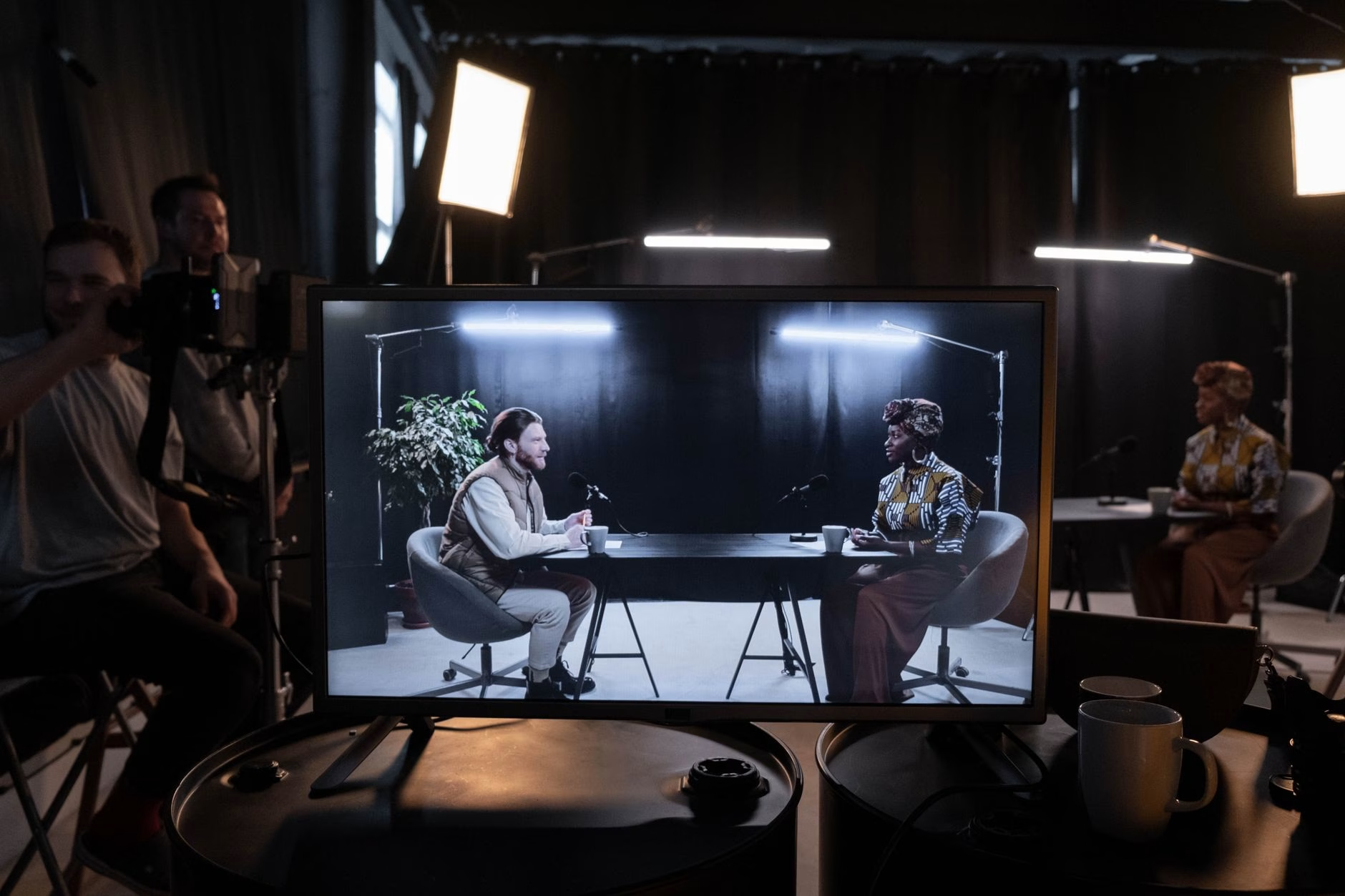
Cover photo by Steve A Johnson on Pexels.
Frequently Asked Questions
How much does AI ad localization actually cost for 10 languages? +
Roughly $150 to $250 in tooling when spread across a paid subscription, plus $50 to $100 for native-speaker QC on Fiverr. An agency doing the same scope typically quotes $5k to $15k and takes 3 to 6 weeks. AI quality is for market testing, not for replacing a human team in a market that proves out.
What's the difference between transcreation and translation for ads? +
Translation converts sentences word for word and fails on timing and idiom. Transcreation recreates the sell: same emotional hook, same CTA, rewritten for the market's buying triggers. Timing makes this non-negotiable, because German audio runs 15 to 30% longer than English while Japanese runs 10 to 20% shorter.
When should I choose HeyGen over ElevenLabs for dubbing? +
Use HeyGen when lip-sync fidelity matters, like a talking-head UGC ad where the original face and voice carry the persuasion. Use ElevenLabs when you want a licensed market-native actor speaking over B-roll, where lip-sync doesn't matter. For a cheap one-or-two-language test, Rask AI or Captions are fine starting points.