 Lucas Oliveira
Demystify the actual cost of production-grade AI voice agents by exploring the five distinct pricing layers. Learn how to estimate your real cost per live interaction, compare managed systems with BYOK stacks, and discover why custom dashboards are essential for tracking fluctuating API bills.
Deploying high-quality voice bots requires a clear view of your profit margins. Many business leaders rely on basic pricing guides or assume a flat advertised rate covers everything, only to find real-world bills are two to three times higher. Let's break down the multi-layered pricing structures of AI voice agents so you can project accurate budgets and scale without surprises.
The Illusion of the "Flat Rate"
Advertised platform rates like $0.07 per minute rarely tell the whole story. Most providers only show their orchestration fee—the cost of the software that glues your system together. In reality, every production-grade call relies on five separate technical layers, each with its own metered pricing. Think of it like a budget airline ticket: the base fare looks cheap, but baggage fees, seat selection, and taxes quickly double the total cost.
The 5 Structural Cost Layers of an AI Voice Call
Every second your AI agent spends on a call, it cycles through a loop of listening, processing, and speaking. Here is how those actions break down financially:
- Platform Orchestration: Services like Vapi or Retell charge $0.05 to $0.07 per minute to route data packets between phone lines and your AI models.
- Speech-to-Text (STT): This is how your agent hears. Models like Deepgram Nova-2 convert speech to text in real-time for roughly $0.004 to $0.01 per minute.
- Language Models (LLMs): This is the brain. Models like GPT-4o or Claude 3.5 Sonnet bill by tokens. Because each conversational turn resends the previous chat history to the model, costs scale exponentially on longer calls, ranging from $0.02 to $0.15 per minute.
- Text-to-Speech (TTS): This is how your agent speaks. Real-time generators like ElevenLabs charge per character. Highly realistic, emotionally expressive voices represent your largest cost layer at $0.04 to $0.18 per minute.
- Telephony: This is the physical phone line. Routing calls through carriers like Telnyx adds another $0.01 to $0.02 per minute.
Stacked together, a highly realistic voice agent averages $0.12 to $0.25 per minute all-in. Any estimate lower than this likely uses robotic, high-latency voices or weak, easily confused language models.
Managed Platforms vs. Bring-Your-Own-Key (BYOK) Stacks
When building your system, you face a critical choice: buy a fully managed platform or build a custom stack. Platforms like Bland AI or Retell offer quick, pre-configured setup. However, they bake convenient markups into every single layer, meaning you pay a premium on every character and token.
To avoid these markups, advanced teams use Vapi or custom orchestrators to Bring Your Own Key (BYOK). By inputting your own developer credentials for OpenAI, Deepgram, and ElevenLabs, you pay raw costs directly to the providers. This strategy drastically lowers long-term unit economics and is standard practice for modern AI workflows.
Cost Per Minute vs. Cost Per Live Interaction
Many business owners calculate ROI by simply multiplying their all-in per-minute cost by total phone minutes. This ignores operational realities. In production, a massive portion of outbound dials results in voicemail, busy signals, or instant hang-ups.
Even if your agent spends 45 seconds listening to an answering machine, you still pay for routing, transcription, and orchestration. To find your true customer acquisition and support costs, calculate the cost per live interaction by dividing your total monthly bill by your actual successful, high-value conversations.
Why Custom BI Dashboards are Mandatory
Because costs fluctuate with every spoken syllable and system prompt update, generic invoices are useless for budgeting. If your team updates an agent's prompt and accidentally doubles the token count, you will not notice until the bill arrives. You cannot optimize what you do not actively measure.
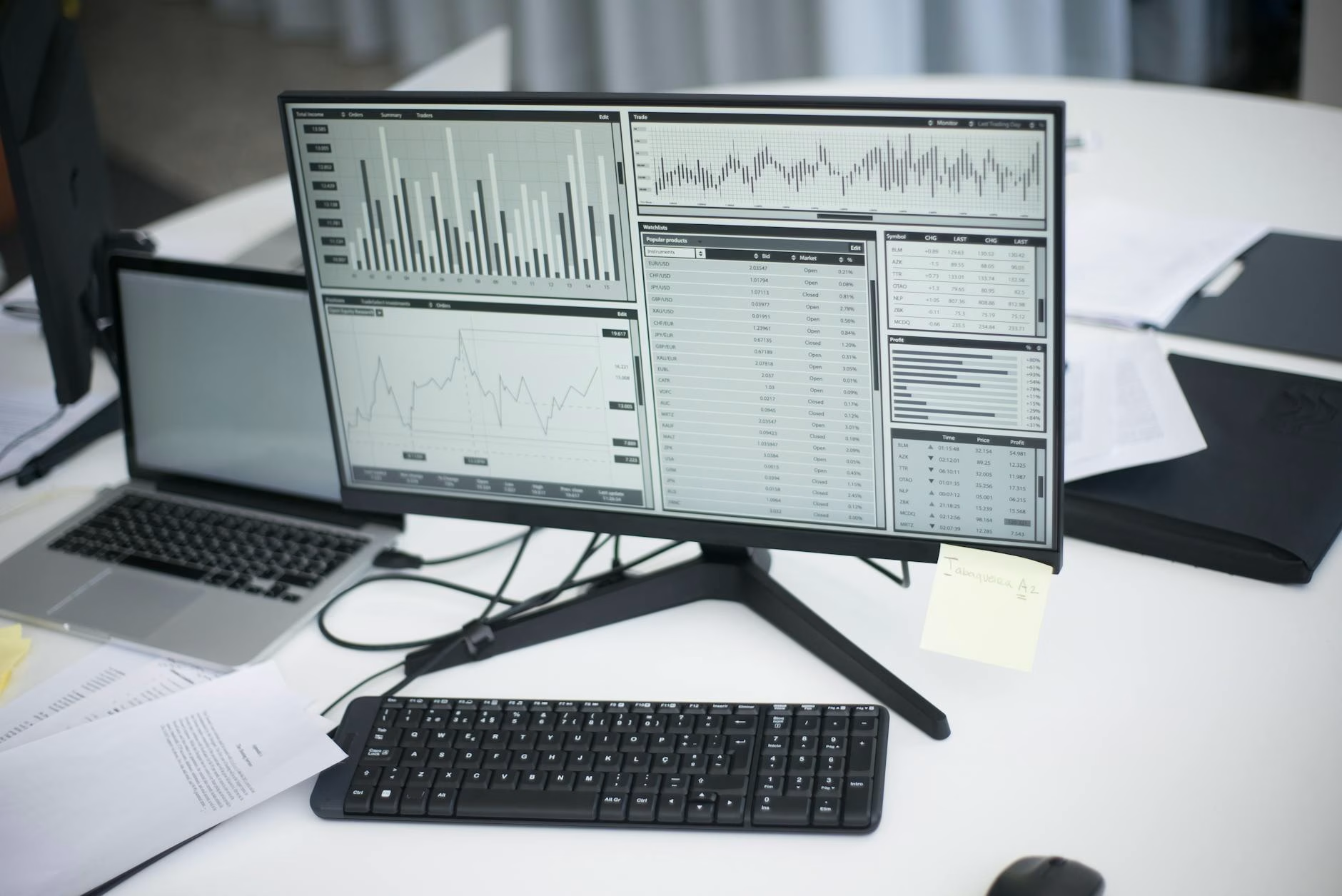
To scale voice automation safely, you need custom business intelligence (BI) dashboards that track API spending call-by-call. Centralizing this data lets you see which prompts, models, and voice engines yield the highest ROI. At Nova Pixel, we help startups design clean, scalable data systems that bypass these pitfalls, mirroring the structured logic of clean semantic layers to keep metrics organized.
Off-the-shelf software templates might save you a few hours during setup, but tailored solutions always win on long-term unit economics. By taking ownership of your infrastructure, your business secures lower operational costs, higher system reliability, and complete control over customer interactions.
Cover photo by MART PRODUCTION on Pexels.
Frequently Asked Questions
What is the average all-in cost per minute for an AI voice agent? +
While platforms advertise base fees of $0.05 to $0.07 per minute, a realistic voice agent typically costs $0.12 to $0.25 per minute all-in. This total includes speech-to-text, LLM tokens, realistic text-to-speech, and carrier telephony.
What is Bring Your Own Key (BYOK) and how does it save money? +
BYOK is a deployment model where you connect your own developer API credentials for services like OpenAI, Deepgram, and ElevenLabs to an orchestration platform. This avoids platform markups, letting you pay raw infrastructure prices directly to the providers.
Why are standard voice agent invoices hard to predict? +
Because text-to-speech costs are calculated by character counts and language models charge by conversational tokens, pricing fluctuates call by call. A longer conversation or a sudden prompt change will cause bills to spike, making custom BI dashboards essential.